
400-900-9767
400-900-9767
当前位置:首页 > 考研频道 > 考研真题 > 2025年全国硕士研究生招生考试英语(一)
发布时间:2026-03-19 关键词:硕士研究生招生考试英语一
摘要:2025年全国硕士研究生招生考试英语(一)
2025 年全国硕士研究生招生考试英语(一)
Directions:
Read the following text. Choose the best word(s) for each numbered blank and mark A, B, C or D on the ANSWER
SHEET. (10 points)
Located in the southern Peloponnesian peninsula, Pavlopetri (the modern name of the site) emerged as a Neolithic settlement around 3500 B.C. This area of the Aegean Sea is 1 to earthquakes and tsunamis, which caused the city to 2 sink. The slow sea level rise in the Mediterranean 3 the city more than 3,000 years ago.
For millennia, the city’s 4 lay unseen below some 13 feet of water. They were covered by a thick layer of sand 5 the island of Laconia. In recent decades, shifting 6 and climate change have eroded a natural barrier that 7 Pavlopetri. In 1967, a scientific survey of the Peloponnesian coast was 8 data to analyze changes in sea levels 9 British oceanographer Nicholas Flemming first spotted the sunken 10 . A year later, he returned with a few students to 11 the location and map the site. The team identified some 15 buildings, courtyards, a network of streets, and two chamber tombs. 12 the exciting initial finds, the site would lie 13 for decades before archaeologists would return.
In 2009 archaeologists Chrysanthi Gallon and Jon Henderson 14 excavation of Pavlopetri in cooperation
with the Greek Ministry of Culture. Since the 1960s, underwater archaeology 15 and tools had made huge advances. The team 16 robotics, sonar mapping, and state-of-the-art graphics to survey the site. From 2009 to 2013 they were able to bring the underwater town to 17 . Covering
about two and a half acres, Pavlopetri’s three main roads 18 some 50 rectangular buildings, all of which had open courtyards. Excavations revealed a large number of Minoan-style loom weights, 19 Pavlopetri was a thriving trade center with a 20 textile industry.
|
1. A. relevant |
B. prone |
C. available |
D. alien |
|
2. A. accidentally |
B. frequently |
C. gradually |
D. temporarily |
|
3. A. disguised |
B. submerged |
C. relocated |
D. isolated |
|
4. A. legends |
B. programs |
C. remains |
D. surroundings |
|
5. A. across |
B. off |
C. under |
D. via |
|
6. A. currents |
B. rivers |
C. seasons |
D. winds |
|
7. A. elevated |
B. separated |
C. comprised |
D. protected |
|
8. A. gathering |
B. restoring |
C. updating |
D. supplying |
|
9. A. when |
B. until |
C. after |
D. once |
|
10. A. belongings |
B. resources |
C. products |
D. structures |
|
11. A. preserve |
B. select |
C. display |
D. examine |
|
12. A. Despite |
B. Unlike |
C. Besides |
D. Among |
|
13. A. unchallenged |
B. unknown |
C. unorganized |
D. undisturbed |
|
14. A. suspended |
B. transferred |
C. resumed |
D. canceled |
|
15. A. policies |
B. theories |
C. documents |
D. techniques |
|
16. A. ordered |
B. provided |
C. employed |
D. adjusted |
|
17. A. effect |
B. light |
C. reality |
D. mind |
|
18. A. crossed |
B. connected |
C. blocked |
D. altered |
|
19. A. expecting |
B. suggesting |
C. predicting |
D. recalling |
|
20. A. robust |
B. diverse |
C. marginal |
D. dependent |
Part A Directions:
Read the following four texts. Answer the questions below each text by choosing A, B, C or D. Mark your answers
on the ANSWER SHEET. (40 points)
The grammar school boy from Stratford-upon-Avon has landed a scholarly punch after groundbreaking research showed that Shakespeare does benefit children’s literacy and emotional development. But only if you act him out.
A study found that a “rehearsal room” approach to teaching Shakespeare broadened children’s vocabulary and the complexity of their writing as well as their emotional literacy. “The research shows that the way actors work makes a big difference to the way children use language and also how they think about themselves,” Jacqui O’Hanlon of the Royal Shakespeare Company (RSC), which commissioned the study, said.
The randomised control trial involved hundreds of year 5 pupils—aged nine and ten—at 45 state primary schools that had not been “previously exposed to RSC pedagogy.” They were split into target and control groups and asked to write, for example, a message in a bottle as Ferdinand following the shipwreck in The Tempest. The target group were given a 30-minute drama-based activity to accompany the passage.
The peer-reviewed results showed that the target group of pupils drew on a wider vocabulary, used words “classed as more sophisticated or rarer”, and wrote at greater length. They also
“appear to be more comfortable writing in role...while [control] pupils imagine how they themselves would react to being shipwrecked, [target] children put themselves in the shoes of a literary character and express that character’s emotion”. The Time to Act study, which is published by the RSC this week, also found that while control pupils relied on “desert island clichés” such as palm trees, target pupils were “more expansive [giving] a broader picture of the sky, the sea and the atmospheric conditions”.
O’Hanlon said she had been most surprised by the “emotional literacy that was evident in the [target] children’s writing” and that they were “more resilient in their writing, more hopeful”. She added “The emotional understanding was very evident and it is probably related to the [rehearsal room process] where you are used to trying to imagine your way through. They were comfortable in describing different emotional states and part of what you do in drama is put yourself in different
shoes.” The study showed the importance of embedding arts in education, she said.
But could the results be replicated with any old dramatist? O’Hanlon said more research would be needed but suggested that Shakespeare’s use of 20,000 words, compared with the everyday 2,000 words, gave a “massive expansion of language into children’s lives”, which was combined with children “using their whole bodies to bring words to life”.
I was shocked to learn recently that some scientists want to scale back their research in an effort to decrease carbon emissions. The crisis is here, they said, and we need to cut back on our energy-intensive modelling. At the very least, we need to make our energy use far more sustainable.
It is unarguable that our laboratories, scientific instruments, rockets and satellites — the tools we scientists need to measure the planet’s pulse — demand significant amounts of energy both in their construction and operation. And it is equally true that science’s unrelenting appetite for information has caused a mushrooming of energy-intensive data centres around the world. According to the International Energy Agency, these buildings now consume
about 1 percent of the world’s electricity.
However, this is a price we must pay for understanding the world. How can we inform decision makers about the best ways to bring down carbon emissions if we can’t track the amount of carbon dioxide in the atmosphere, where it’s coming from and who’s producing it? The carbon emissions from technological research are well spent: ultimately this research will safeguard the future of our planet.
It can be hard for scientists to make the case because our work is complex, often takes place behind closed doors and does not always lend itself to easy interpretation or explanation. But demonstrating the efficacy of science will be crucial if we are to solve humanity’s greatest challenges. It is all too easy to feel paralysed in the face of daunting problems such as climate change and to do nothing. But then I think of a friend’s daughter who turned her fears into action: she became a wind energy engineer and now thrives on delivering renewable energy, limiting emissions.
Recognising the hope that science and engineering can bring was the impetus behind the creation of the Millennium Technology Prize, which is now entering its 20th year as a celebration of human ingenuity. One of the past winners, Professor Martin Green from the University of New South Wales, Australia, is the inventor of the Passivated Emitter and Rear Cell technology which is now found in most of the world’s solar panels. Thanks to his invention, we have a real chance to decrease
the world’s carbon emissions.
Every day, scientists, technologists and engineers are discovering new ways to exploit renewable energy sources and develop techniques not just to use power more intelligently but to power our intelligence. A great example of this is Europe’s largest supercomputer, LUMI in Finland, which is
astonishingly carbon-negative. Established in an old paper mill, it is powered by a nearby river and its remote heat warms the people who
live in the surrounding town of Kajaani.
If the world is to meet its net-zero ambitions, we must think hard about how we can deliver sustainable computing and deliver more LUMIs.
Ever since taking on Netflix Inc. at its own game, old Hollywood has struggled to turn a profit in streaming, with
the likes of Disney+, Peacock and Paramount+ losing billions of dollars each year, sparking concerns that the
services will never be as profitable as cable once was. But the age of streaming has been a boon for some
unintended winners: pirates that use software to rip a film or television show in seconds from legitimate online
video platforms and host the titles on their own, illegitimate services, which rake in about $2 billion annually from
ads and subscriptions. With no video production costs, illegal streaming sites have achieved profit margins
approaching 90%, according to the Motion Picture Association (MPA), a trade group representing
Hollywood studios that’s working to crack down on the thousands of illegal platforms that have
cropped up in recent years.
Initially the rise of legitimate online businesses such as Netflix actually helped curb digital piracy, which had largely been based on file uploads. But now piracy involving illegal streaming services as well as file-sharing costs the US economy about $30 billion in lost revenue a year and some 250,000 jobs, estimates the US Chamber of Commerce’s Global Innovation Policy Center. The global impact is about $71 billion annually.
“The people who are stealing our movies and our television shows and operating piracy sites are not mom and pop operations,” says Charlie Rivkin, chief executive officer of the MPA. “This is organized
crime.” Rivkin joined the MPA in 2017 after the organization failed five years earlier to build consensus
between Hollywood and Silicon Valley to win passage of legislation in Congress aimed at stopping online
piracy. In 2017 the association formed the Alliance for Creativity and Entertainment (ACE), an enforcement
task force of about 100 detectives circling the globe to help local authorities arrest streaming pirates.
ACE says it’s helped shrink the number of illegal streaming services in North America to 126, from more than 1,400 in 2018, aided in part by the MPA’s support for a 2020 federal law that made large-scale streaming of copyright material a serious crime.
Consulting firm Parks Associates predicts that legitimate US streaming services’ cumulative loss from piracy since 2022 will reach $113 billion in the next two years. “While there is some optimism that emerging countermeasures and best practices may see piracy begin to plateau by 2027, there is no consensus among stakeholders as to when it may begin to decline,” says analyst Steve Hawley.
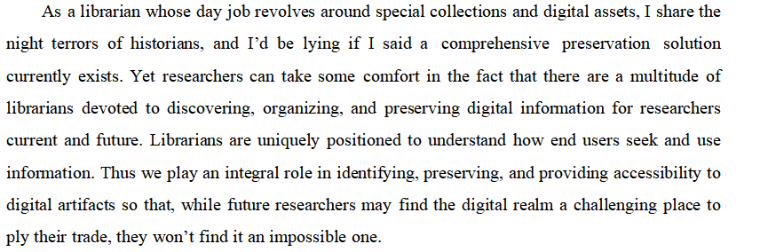
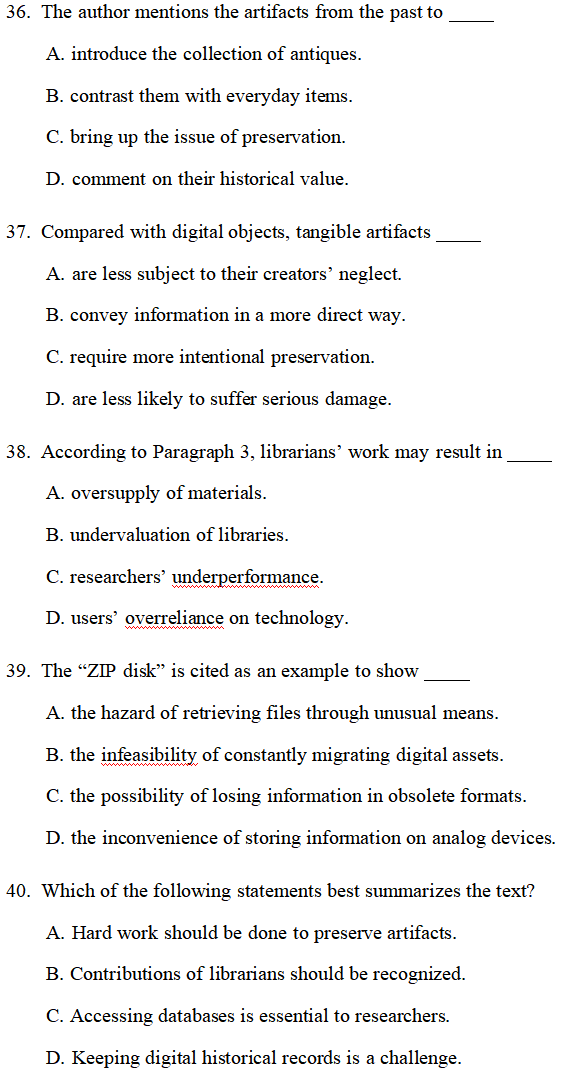
Visit any antiques store and you’ll encounter artifacts from the past: photographs, letters, a brochure detailing the Sinclair dinosaur exhibit from the 1964-1965 World’s Fair, the ephemera of history. Yet these objects aren’t truly ephemeral, because they’re still here, decades, even centuries later.
Why? Because they’re tangible.
Have you pondered the life cycle of intangible formats, digital information, given that those who produce these artifacts seldom make provision for their long-term preservation? For millennia, we’ve known what we’ve known due to artifacts that have survived, often despite their original creators’ neglect. The thing itself is the medium that delivers the information. At the time of creation, no attempts were made at intentional preservation, yet analog materials have a chance of surviving and serving as the historical record that biographers,
historians, and novelists rely on. Libraries and archives have traditionally shouldered the responsibility of organization, preservation, and access to information. Thus, librarians digitize the tangible so that researchers the world over can quickly search and access their holdings. The result is an embarrassment of historical riches, which brings its own needle-and-haystack problems.
Librarians’ selfless devotion can act against us when users point to universality of access by holding up a cellphone and saying, “it’s all in here” as evidence that libraries are less vital for researchers today. Yet how was that universality of access made possible and, perhaps more importantly, how is it maintained? Who curates what is preserved? When it comes to born-digital information, the terrifying answer can be: if not librarians and archivists, then no one. Digital information requires a great deal more care than analog.
Even when a digital object is preserved, it may only be the carrier that’s saved, not the information itself. As technology advances and a format becomes obsolete, the object is useless. Have you ever stared helplessly at a ZIP disk, thinking: how do I get the files off this? Without constant migration of digital assets, a nightmare about the foreseeable future is what keeps historians up
at night: a historical record that abruptly stops when digital replace analog.
考研1v1规划
选对院校| 做好规划 | 全力备考
考研备考,智选新航道~
轻松备考,高效提分!
专业师资,让复杂知识变简单~
梦想起航,新航道助你一战成硕!

北京新航道好轻松考研->>点击官方在线咨询<< 官方咨询电话:400-900-9767



 美国留学方案
 英国留学方案
 加拿大留学方案
 澳新留学方案
 英联邦留学方案
 单项服务
单项服务
 欧洲留学方案
 亚洲留学方案